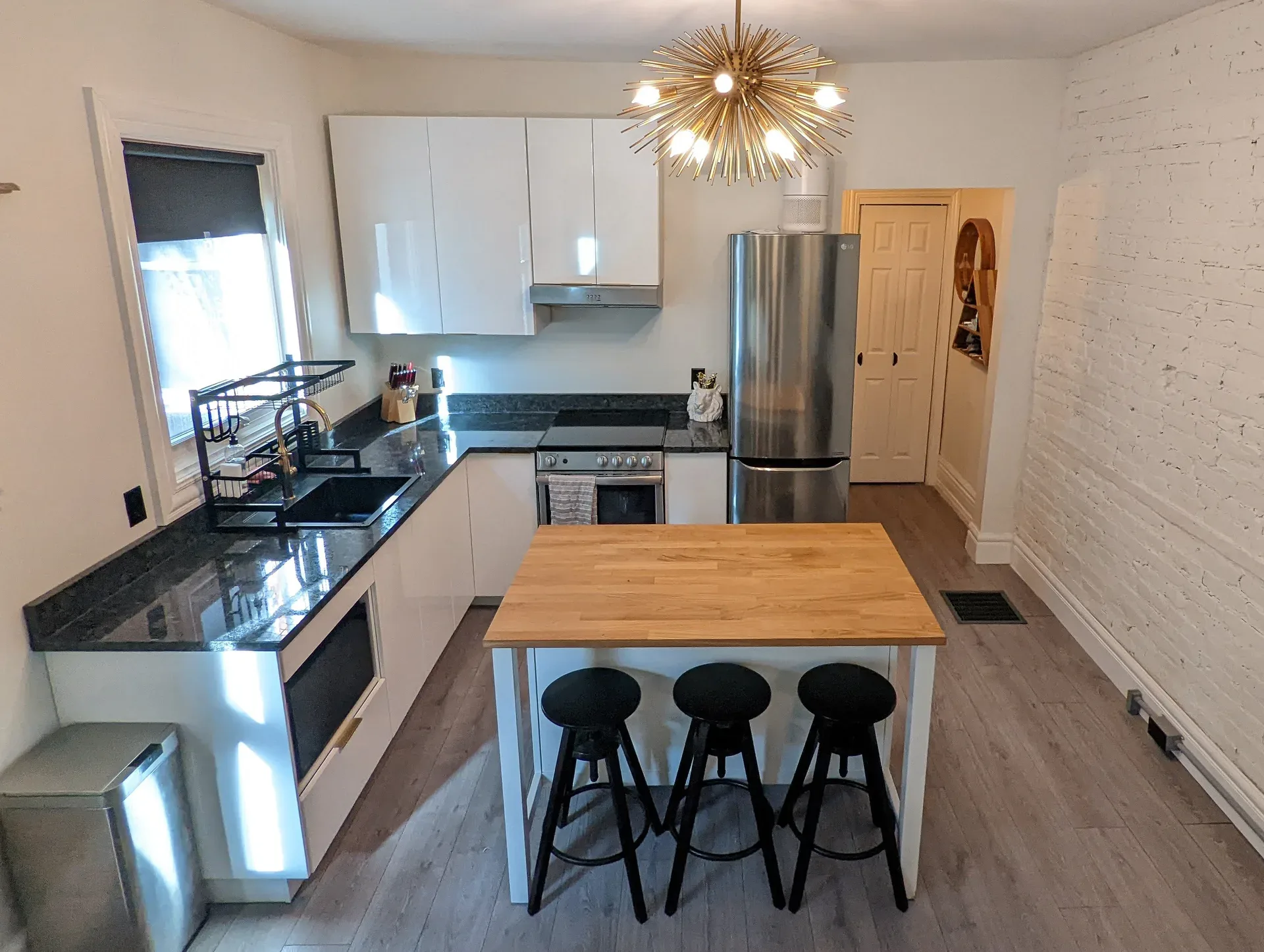
A unit at 158 Hunter St E, the worked example in this guide
When you look at an income property, the listing tells you how many units it has and what it looks like. The income statement tells you whether it makes sense as an investment. Most four-unit buildings come with a simple one-page ledger, and every figure on it rolls into one of five lines. Here is how to read it, using 158 Hunter St E as a worked example.
1. Gross rental income
This is the total rent collected across all units before any costs. For 158 Hunter St E, the four units rent for $2,080, $1,795, $2,250, and $1,450 per month. Add those up and you get $7,570 per month, or $90,840 per year. That is the top line: the money the building can generate with all units rented at the stated rents.
Check the individual unit rents against the local market. A healthy ledger is easy to compare with what similar units actually rent for in the area.
2. Vacancy allowance
No building stays 100 per cent rented forever. Tenants move, units get refreshed, and there is always some gap. Most owners assume a vacancy allowance of around 4 to 5 per cent of gross income. On $90,840, a 4 per cent allowance is roughly $3,634 per year. A conservative buyer budgets for it even when the building is fully tenanted today.
3. Operating expenses
These are the ongoing costs of running the building: property tax, utilities such as electricity and gas, water-heater rental, insurance, internet, and management. At 158 Hunter St E the seller's documents list a stated total of about $1,315.95 per month, or $15,791.36 per year.
Look past the total at the individual lines. Are the utilities paid by the owner or the tenants? Is the water heater rented? Is there a management fee? Those details determine how the numbers behave after you buy.
4. Net operating income
Net operating income, or NOI, is gross rental income minus operating expenses and a vacancy allowance, before mortgage payments. At 158 Hunter St E, the listing agent states a net income of $71,929 per year after operating expenses and vacancy.
NOI is the number that matters most, because it is the cash flow available to service the mortgage and to pay you. If it does not cover the debt comfortably, the building is not working hard enough.
5. Cap rate
The cap rate divides net operating income by the property's value, giving a quick return-on-investment figure that is independent of financing. For 158 Hunter St E, $71,929 of net income on a stated value of $999,999 works out to a cap rate of about 7.21 per cent.
A higher cap rate usually means more income relative to price, and often more risk or more active management. A lower cap rate often reflects a stronger location or newer building. The right number depends on your goals and your tolerance for work.
The figures in this article are as provided by the seller's documents for 158 Hunter St E. They are estimates, not guarantees. Verify every number independently and consult your own accountant and lender before purchasing.